The Brunswikian Lens Model is a way in which “individuals make inferences about the characteristics of others” (Walther). It is said that when an individual has cues with a high level of validity (cues that truly reflect one’s personality) and actually utilizes these cues (exploitation of valid cues), and individual can reach functional achievement and therefore be accurately judged by other outside individuals. I decided to analyze one of my acquaintances on Facebook, “Kristin”, a girl whom which I am not extremely familiar with. Following are the four individual—environmental links that all helped me to assess information about Kristin’s personality and style of life.
A self-directed identity claim is an inwardly defined claim that one makes about themselves. Kristin is married to a girl on Facebook who attends a university other than her own. I believe that this union could be considered an inside joke between Kristin and her “wife” because Kristin has additionally indicated that she is a “female” interested in “men”. This marriage is simply a constant reminder of her strong friendship with her “wife” and is purely self-directed because I believe that not many of her Facebook friends put much thought into her inside joke with her friend from home.
An other-directed identity claim is a claim an individual makes about him or herself and purposefully, publicly displays on CMC so that others can view it. An example of an other directed identity claim are some of the applications Kristin has added to her Facebook homepage. For example, Kristin has a “Movies” application displayed in her profile. She seems to be an active user of this application because she has rated over 75 movies and shared her favorite movies with her other friends who have this application added. This application is purely directed towards her other Facebook friends and gives them some additional information about Kristin in which they can hopefully relate to.
Interior residue is proof of one’s behaviors or actions interior to a specific space. On Kristin’s Facebook, an example of interior residue would be her news-feed. I cannot assess information directly from Kristin’s news-feed but I can assess information about Kristin that shows up on my Facebook news-feed. Kristin shows up repeatedly on my news-feed, which is exactly how I came across the idea of analyzing her profile for this assignment. The fact that she comes up on my news-feed on almost a daily basis is proof of two specific things about Kristin’s Facebook usage: 1.) She is an active user of Facebook (writing on other’s walls, adding applications, editing her user information to reflect her life, etc. daily) and 2.) She is very open and public about these behaviors. I believe that many Cornell Facebook users are quite “private” with their Facebook use. For example, they make their profiles available only to their friends, they remove themselves from other’s news-feed and delete their own mini-feed by editing their privacy options. Kristin doesn’t manage her Facebook in this manner. Either she wants all her friends on Facebook to have proof of whom she’s friends with or who writes on her wall or she is oblivious to how evident her actions on Facebook are.
Exterior residue is evidence of things one does outside of an online space, for example photos reflecting one’s activities and life outside of Facebook. Kristin has many photo albums (14 to be exact) of her and her friends out partying. Therefore, I feel it is safe to assess that when Kristin isn’t studying for prelims or engaging in the basic necessities activities (i.e., sleeping, eating), she spends much of her time hanging out with her friends and being social.
I do not believe that I have reached complete functional achievement of Kristin’s personality because I have only completely analyzed her profile this once. Additionally, I do not know her well enough off-line to verify my observations made through her identity claims and behavioral residue. However, I do believe that by analyzing her Facebook profile, I have a relatively accurate, basic idea of her personality.
Monday, October 22, 2007

Assignment 7
This semester, I am taking an entrepreneurship course in the College of Engineering. As part of the course, we are assigned group members, and within these groups, we come up with a business idea and create a business plan. In order to easily keep in touch with everyone, I created a ‘group’ in my contact list in Gmail. This list contains all the names and respective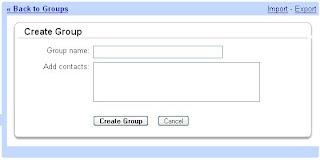 emails of my group members. This group contact list allows me to easily email everyone at once, instead of having to enter each member’s email separately. This created stronger ties among each of the group members. When I need to contact everyone, I simply email my group, and then my group members can easily “Reply to All” in order to reply back to everyone else in the group and keep the online “conversation” going.
 emails of my group members. This group contact list allows me to easily email everyone at once, instead of having to enter each member’s email separately. This created stronger ties among each of the group members. When I need to contact everyone, I simply email my group, and then my group members can easily “Reply to All” in order to reply back to everyone else in the group and keep the online “conversation” going.
 We have a common, shared purpose to email each other—the course work. We are all in the same course, and need to meet at least once a week, face to face, to work on our presentation. So, we share a common language and identity—we are in the same course, and are all engineers. However, we are all different majors within the College of Engineering.
CMC allows our group to communicate and work on our project when we are not meeting face to face. CMC brings our group closer together, because we can communicate with each other even when we are not meeting face to face. In fact, this community as it exists in Gmail would not exist without CMC. CMC allows us to share documents with each other and use our time when we are not in meetings effectively. The online community allows us to easily get in contact with each other and schedule our meetings.

7 - My community
When I logged into the blog to write my post, I immediately noticed Alisha's post about the Big Red Marching Band. This is because I am a member as well (what are the chances of two bandies in the same blog?), so I figured it would be a perfect community to discuss. However, I do not want to post the same thing or add to a post that already does a very good job at describing its relationship to Haythornwaite and Social Network Analysis, so I've decided to go a similar (but sometimes different in terms of theory) route and discuss my membership in the Big Red Pep Band.
The Big Red Pep Band is, like the marching band, a student-run musical ensemble which devotes itself to playing at basically every sporting even besides varsity football (most famously, we play regularly at hockey games). One important thing to note is the carry-over from BRMB members to the pep band. Due to the fact that the pep band's season starts later than marching band, many of the marching band members decide to do both and join pep band from word of mouth. This is not to say that new members aren't welcome and don't join. They do (this plays into common ground which will be discussed later), but there exists a likelihood that new members who are not in marching band might be slightly more confused at first. Also, contrary to marching band, the members do not engage in several social activities a year. This could be because there are more events per year in pep band, so the social aspect seems almost implicit, but I think a large part of this is due to the fact that there are so many dual band members.
Another interesting thing to mention is the lack of online presence, especially in contrast to the marching band. There is a facebook group, but it is not regularly maintained. A site existed several years ago, but has since ceased to function. Like marching band there is a listserv, but the pep band does not have listservs for each section. This may be because pep band is typically smaller and has a limit to those who can attend some events (hockey is capped at 51 members at home games, and 25-41 at away games). Haythornwaite's idea of a social network is created early through a different community and the relationships carry over into a new community.
This also plays into another aspect of Haythornwaite's theory: common ground. Clearly, many of the members share common ground as being members of another existing community. There is also usually an added interest in the sports we perform at, and mostly in creating what is known as the "Lynah atmosphere" at hockey games. Aside from this, there is the simple common ground of playing an instrument, and a desire to learn and perform music.
Lastly, reciprocity also exists in the pep band. Aside from electing student officers (the manager and two conductors per semester, for example), the band also demonstrates this amongst the community. In simple terms, the band gives an atmosphere to a game (whether it's at hockey, lacrosse, or some other sport), and the community responds either by applauding or approaching us to give compliments. In some instances, the teams have shown their gratitude after a big win (the lacrosse team was notable for this last year) by saluting us directly. This all gives many of the members a sense of accomplishment and pride in return for providing entertainment and spirit.
The Big Red Pep Band is, like the marching band, a student-run musical ensemble which devotes itself to playing at basically every sporting even besides varsity football (most famously, we play regularly at hockey games). One important thing to note is the carry-over from BRMB members to the pep band. Due to the fact that the pep band's season starts later than marching band, many of the marching band members decide to do both and join pep band from word of mouth. This is not to say that new members aren't welcome and don't join. They do (this plays into common ground which will be discussed later), but there exists a likelihood that new members who are not in marching band might be slightly more confused at first. Also, contrary to marching band, the members do not engage in several social activities a year. This could be because there are more events per year in pep band, so the social aspect seems almost implicit, but I think a large part of this is due to the fact that there are so many dual band members.
Another interesting thing to mention is the lack of online presence, especially in contrast to the marching band. There is a facebook group, but it is not regularly maintained. A site existed several years ago, but has since ceased to function. Like marching band there is a listserv, but the pep band does not have listservs for each section. This may be because pep band is typically smaller and has a limit to those who can attend some events (hockey is capped at 51 members at home games, and 25-41 at away games). Haythornwaite's idea of a social network is created early through a different community and the relationships carry over into a new community.
This also plays into another aspect of Haythornwaite's theory: common ground. Clearly, many of the members share common ground as being members of another existing community. There is also usually an added interest in the sports we perform at, and mostly in creating what is known as the "Lynah atmosphere" at hockey games. Aside from this, there is the simple common ground of playing an instrument, and a desire to learn and perform music.
Lastly, reciprocity also exists in the pep band. Aside from electing student officers (the manager and two conductors per semester, for example), the band also demonstrates this amongst the community. In simple terms, the band gives an atmosphere to a game (whether it's at hockey, lacrosse, or some other sport), and the community responds either by applauding or approaching us to give compliments. In some instances, the teams have shown their gratitude after a big win (the lacrosse team was notable for this last year) by saluting us directly. This all gives many of the members a sense of accomplishment and pride in return for providing entertainment and spirit.
Assignment 7, Option 1: TEAM
Aside from being a student, my other main social network at Cornell would be with the Varsity Ice Hockey team. Reflecting on Haythomwaite’s (2007) study discussed properties of social network analyses (SNA), common ground and reciprocity.
Our social network is very rich: where contact with each other is highly frequent, everyone knows their roles on the TEAM, seeks improvement and is driven to win. We have obligations with the team almost every day (with a day off a week) that entails on and off ice practices, meetings, extra workouts for people who want to do more, events, community outings, etc. Alumni and past players, and or coaches also still play a party of this community. This social network is obviously, primarily face-to-face based but it also has multiple online communities as well. For instance, many of our alumni are contacted through CMCs as a source to keep in touch, as well as our TEAM site (http://www.cornellbigred.com/News/whockey/2007/10/21/2007%20game%202%20vermont.asp?path=whockey ), listserv within the TEAM, and of course a Facebook group: http://cornell.facebook.com/group.php?gid=2200231068 (which actually has not been updated for 2 years).
As a TEAM our common ground is the TEAM and the goals we have set as a unit. We even have our goals, and attributes painted on our dressing room walls to reiterate the importance of them. Collectively, we also have to pass the same standards to be able to play and are personally accountable for being on time for anything that is TEAM related. In more depth, within this social network (focusing just on the TEAM this year) players are grouped into categories: coaches, staff, forwards, defense, goalies, and “speciality teams” (Penalty Kill and Power Play): where these groups can identify with one another more closely since they also play the same position and understand the roles of that position in more detail than people who do not play the same position.
Reciprocity is a key factor with any sport. Sports deal with a lot of “reading and reacting”: everyone has their roles on the team, as previously stated, however, things do not always play out as practiced. This is when reciprocity will come into play where it is known that if player X was not the first man into the zone when they are “supposed to be” then player Y will take on that role – in which player X will presumably take on the role of player Y. Also, being a part of a TEAM is like being a part of a family where if people do something nice or good to you – that act will tend to be reciprocated. This also ties in with alumni, coaches, and other staff on the TEAM. We get a bunch of alumni support and through the years of doing “Phone-a-thons”, even recent alumni are donating to help the upcoming TEAM, just as the elder alumni.
As I had previously stated, this social network has both online and offline synergies which help tie in the “extended”, not just the immediate,TEAM together through listservs, emails, groups, and such. Let’s go Red!
Our social network is very rich: where contact with each other is highly frequent, everyone knows their roles on the TEAM, seeks improvement and is driven to win. We have obligations with the team almost every day (with a day off a week) that entails on and off ice practices, meetings, extra workouts for people who want to do more, events, community outings, etc. Alumni and past players, and or coaches also still play a party of this community. This social network is obviously, primarily face-to-face based but it also has multiple online communities as well. For instance, many of our alumni are contacted through CMCs as a source to keep in touch, as well as our TEAM site (http://www.cornellbigred.com/News/whockey/2007/10/21/2007%20game%202%20vermont.asp?path=whockey ), listserv within the TEAM, and of course a Facebook group: http://cornell.facebook.com/group.php?gid=2200231068 (which actually has not been updated for 2 years).
As a TEAM our common ground is the TEAM and the goals we have set as a unit. We even have our goals, and attributes painted on our dressing room walls to reiterate the importance of them. Collectively, we also have to pass the same standards to be able to play and are personally accountable for being on time for anything that is TEAM related. In more depth, within this social network (focusing just on the TEAM this year) players are grouped into categories: coaches, staff, forwards, defense, goalies, and “speciality teams” (Penalty Kill and Power Play): where these groups can identify with one another more closely since they also play the same position and understand the roles of that position in more detail than people who do not play the same position.
Reciprocity is a key factor with any sport. Sports deal with a lot of “reading and reacting”: everyone has their roles on the team, as previously stated, however, things do not always play out as practiced. This is when reciprocity will come into play where it is known that if player X was not the first man into the zone when they are “supposed to be” then player Y will take on that role – in which player X will presumably take on the role of player Y. Also, being a part of a TEAM is like being a part of a family where if people do something nice or good to you – that act will tend to be reciprocated. This also ties in with alumni, coaches, and other staff on the TEAM. We get a bunch of alumni support and through the years of doing “Phone-a-thons”, even recent alumni are donating to help the upcoming TEAM, just as the elder alumni.
As I had previously stated, this social network has both online and offline synergies which help tie in the “extended”, not just the immediate,TEAM together through listservs, emails, groups, and such. Let’s go Red!
7 Social Networks for Soccer Players...
Soccer brings people together. After all, it is called "joga bonita" or "the beautiful game" for many reasons. I play for the Cornell Women's Club Soccer team, a group of twenty-three individuals brought together by our love of this beautiful game. Haythornthwaite's social network analysis examines the relationships of communities and the individuals that make them up. The soccer team's community has many social network analysis properties. Haythornthwaite would consider the team in a "Gemeinschaft" or "community view" because the team makes up a very utopic community. We exist in a successul community that is made of of strong interpersonal ties since we see each other so often and have the chance to become close with one another on many different levels. We share lots of face to face interaction through practices, games, road trips and relaxing with one another. The team unites to have one common purpose in having a successful season (so far so good, even though we lost in the Regional final this past weekend). Basically, everyone on the team is connected at all times, providing a very utopic, strong community.
However, even though everyone on the team is friends, there tends to be a mixture of strong and weak ties. While we see each other often, most of us have other "main" groups of friends outside of the team, providing connections to unique resources and vast social networks. While this "strength of weak ties" idea relates to some groups of girls within the team, there certainly are other vert strong ties that we all have to people on the team. There are girls that I am extremely close with, yet we do not have the same friends outside of soccer. This interchangeability of strong and weak ties is interesting because even though Haythornthwaite would consider my close friendships a "strong" tie, she would also consider these relationships "weak" in that each of us has separate social networks outside of the team.
Being on a team that has a unified goal proves Haythornthwaite's common ground principle in my community. The Gemeinschaft" view itself specifically states that shared focus and a common purpose are necessary in order to have a community view. The word "team" denotes that a shared goal is present in the first place. We all look to work as hard as possible everyday in practice in order to win as many games as possible. This past weekend, during the Region 1 tournament in Philadelphia, our common ground was the goal of winning the tournament. While we reached the finals and lost in penalty kicks, everyone still felt extremely happy about how we played. Since we all have a common interest in the success of the team, it was easy to develop friendships with these girls because we feel similar to one another. There is a shared commitment involved in creating a successful community.
Because most of the ties I have developed with the girls on the team have been strong, there is an innate sense of reciprocity since we are all there for one another on a daily basis. We stick up for each other when someone on another team decides to hurt one of our players or backtalk to us. We are there to support one another. Reciprocity also comes in the form of how each person shows their dedication for the team. Now that we have entered the most important part of our season, playing time may no longer be equal. Those who show the most dedication and effort will be reciprocated with the most playing time.
CMC does play a large role in the soccer team. We have a website, where we each have pictures and information about us, as well as team photos, schedules, and lots of other interesting informaiton (check it out! http://www.rso.cornell.edu/cornellfc/ ). We email on a daily basis to communicate about schedule changes, practice information, who is driving to games, and any other information such as social events. We also have a group on Facebook. So CMC plays an integral role in how the team communicates on a daily basis. Etzioni and Etzioni say that, "communities that combine both face to face and CMC systems would be able to bond better and share values more effectively than communities that rely upon only one or the other mode of communication." It is evident that CMC in addition to face to face interaction gives the team a better sense of community. It is also said that communities with strong ties tend to use more media to communicate, proving that CMC only helps to enhance community relationships rather than downplay them. This is definitely true in terms of the Cornell Women's Club Soccer Team. Ahh...what a "joga bonita"!
http://comm245blue.blogspot.com/2007/10/71-gemeinshaft-must-have-been-greek.html
http://comm245blue.blogspot.com/2007/10/assignment-7-option-1-taking-catherwood.html
However, even though everyone on the team is friends, there tends to be a mixture of strong and weak ties. While we see each other often, most of us have other "main" groups of friends outside of the team, providing connections to unique resources and vast social networks. While this "strength of weak ties" idea relates to some groups of girls within the team, there certainly are other vert strong ties that we all have to people on the team. There are girls that I am extremely close with, yet we do not have the same friends outside of soccer. This interchangeability of strong and weak ties is interesting because even though Haythornthwaite would consider my close friendships a "strong" tie, she would also consider these relationships "weak" in that each of us has separate social networks outside of the team.
Being on a team that has a unified goal proves Haythornthwaite's common ground principle in my community. The Gemeinschaft" view itself specifically states that shared focus and a common purpose are necessary in order to have a community view. The word "team" denotes that a shared goal is present in the first place. We all look to work as hard as possible everyday in practice in order to win as many games as possible. This past weekend, during the Region 1 tournament in Philadelphia, our common ground was the goal of winning the tournament. While we reached the finals and lost in penalty kicks, everyone still felt extremely happy about how we played. Since we all have a common interest in the success of the team, it was easy to develop friendships with these girls because we feel similar to one another. There is a shared commitment involved in creating a successful community.
Because most of the ties I have developed with the girls on the team have been strong, there is an innate sense of reciprocity since we are all there for one another on a daily basis. We stick up for each other when someone on another team decides to hurt one of our players or backtalk to us. We are there to support one another. Reciprocity also comes in the form of how each person shows their dedication for the team. Now that we have entered the most important part of our season, playing time may no longer be equal. Those who show the most dedication and effort will be reciprocated with the most playing time.
CMC does play a large role in the soccer team. We have a website, where we each have pictures and information about us, as well as team photos, schedules, and lots of other interesting informaiton (check it out! http://www.rso.cornell.edu/cornellfc/ ). We email on a daily basis to communicate about schedule changes, practice information, who is driving to games, and any other information such as social events. We also have a group on Facebook. So CMC plays an integral role in how the team communicates on a daily basis. Etzioni and Etzioni say that, "communities that combine both face to face and CMC systems would be able to bond better and share values more effectively than communities that rely upon only one or the other mode of communication." It is evident that CMC in addition to face to face interaction gives the team a better sense of community. It is also said that communities with strong ties tend to use more media to communicate, proving that CMC only helps to enhance community relationships rather than downplay them. This is definitely true in terms of the Cornell Women's Club Soccer Team. Ahh...what a "joga bonita"!
http://comm245blue.blogspot.com/2007/10/71-gemeinshaft-must-have-been-greek.html
http://comm245blue.blogspot.com/2007/10/assignment-7-option-1-taking-catherwood.html
7 Me and my TB?
No, not tuberculosis.
I work at the Statler, both in the kitchen and at the TB (Taverna Banfi). I work over 40 hours a week and have made some very strong ties with many of the people who are like a second family to me. Some ties are stronger than others, but I feel like a welcome member of the Statler Family (the community I will be discussing).
I will examine the situation specifically based on my experiences and observations of four aspects of an SNA approach:
Social Network properties
Common Ground
Reciprocity
SNA PROPERTIES
The SNA properties focus on the interactions based within the community, i.e. with whom do people communicate and with whom do they associate. It also looks at the value of strong and (maybe more importantly) weak ties.
I find that my strong ties in the community are with those whom I respect and whose opinions I value. I feel that I can open up to management about issues and share my feelings. I have had an issue with not being tipped out properly and one of managers and a full-time staffer both gave me similar, successful advice on how to handle the situation. Some may argue that this may seem to fly in the face of the "strength of weak ties"; however, I find the strength of weak ties comes from a social capital perspective. This situation was more of a personal issue and the strong ties were necessary for full disclosure and my comfort.
I have also discovered the strength of my weak ties. The weak ties have also helped me to network and find a summer internship. I also have learned about the collaborative degree program with the CIA through students actually from the CIA. I am a foodie and I love to cook. My passion and the weak ties I form now are possible contacts in the future for advice, housing, internships, and careers. I can also attain knowledge now about best and worst practices. Networking is key in the Hotel School, as I have heard many times over.
I have found that the Statler is a community because of the interaction aspect above pairwise communication. We are a family. Everyone learns everyones names and offers advice and learning opportunities. We are all there for guest satisfaction and to do our best to learn and excel at what we do. Everyone helps everyone achieve their goals.
Mr. Adie, the GM of the hotel, knew me by name my second week on the job. His smile and encouragement and concern for me overworking are all examples of the ties from the very top to the entry-level jobs. As I said, he recognizes that if I am happy, then I will give better service which will, in turn make the hotel do better. This reflects well on him and we all benefit. (Thank you Organizational Behavior).
COMMON GROUND
We in the restaurant share a common ground in our passion for foodservice. In order to work in the high stress restaurant environment, everyone must enjoy what they do. We fall into two categories: students and full timers. The full timers love teaching students new aspects of guest service (at TB) or culinary theory (in the kitchen). The students, in turn, are eager helpers and ready and excited to learn.
We share a common workspace and a common interest. We are all commmited to excellence and guest satisfaction. Also, conversely, we do not always share the same values. Some values are similar, but we have learned to respect each other as individuals within the community context. At the end of the day, we are all actors and indviduals and have learned to accept that.
RECIPROCITY
As I stated earlier, two main types of employees are at the Statler, the full time staff and the students. We students are eager to help the full time staff perform their job well. In turn, the full time staff help teach the students new concepts and terms, while utilizing their help to get jobs done faster. Some stubents are on practicums and externships, while some are working part time; however, all are eager to help and learn.
Managers recognize that happy employees equal happier guests. Happier guests, in turn, make the managers jobs easier nad increase the return rate and revenue at the hotel. This in turn makes managers happier. This cycle of love at the Statler is a prime example of everyone's reciprocity within the community.
* * * * * * * * * * * * * *
I feel that my work environment represents an amazing social network and community. It has weak and strong ties, common ground reciprocity, social capital (in networking opportunities for careers and internships), human capital (culinary and foodservice skills and knowledge).
Haythornwaite would look at who interacts with whom and who hangs out with whom. I feel a part of a larger family at the Statler. If I needed help or a shoulder oto cry on, I could go to almost anyone and they would listen and offer support. Parties are open to anyone. Everyone will pass you in the hall with a smile and a greeting, despite only seeing you once before. We all hang out outside of work. I guess its just a Hotelie state of mind that has overflown into the Statler workplace.
On that note, I don't really give my money to anyone, so that aspect doesn't really apply. I also neither care to whom anyone else gives their money. That aspect just isn't applicable.
I have a little more to say, but I have gone on long enough already. Sorry about the verbosity.
I work at the Statler, both in the kitchen and at the TB (Taverna Banfi). I work over 40 hours a week and have made some very strong ties with many of the people who are like a second family to me. Some ties are stronger than others, but I feel like a welcome member of the Statler Family (the community I will be discussing).
I will examine the situation specifically based on my experiences and observations of four aspects of an SNA approach:
Social Network properties
Common Ground
Reciprocity
SNA PROPERTIES
The SNA properties focus on the interactions based within the community, i.e. with whom do people communicate and with whom do they associate. It also looks at the value of strong and (maybe more importantly) weak ties.
I find that my strong ties in the community are with those whom I respect and whose opinions I value. I feel that I can open up to management about issues and share my feelings. I have had an issue with not being tipped out properly and one of managers and a full-time staffer both gave me similar, successful advice on how to handle the situation. Some may argue that this may seem to fly in the face of the "strength of weak ties"; however, I find the strength of weak ties comes from a social capital perspective. This situation was more of a personal issue and the strong ties were necessary for full disclosure and my comfort.
I have also discovered the strength of my weak ties. The weak ties have also helped me to network and find a summer internship. I also have learned about the collaborative degree program with the CIA through students actually from the CIA. I am a foodie and I love to cook. My passion and the weak ties I form now are possible contacts in the future for advice, housing, internships, and careers. I can also attain knowledge now about best and worst practices. Networking is key in the Hotel School, as I have heard many times over.
I have found that the Statler is a community because of the interaction aspect above pairwise communication. We are a family. Everyone learns everyones names and offers advice and learning opportunities. We are all there for guest satisfaction and to do our best to learn and excel at what we do. Everyone helps everyone achieve their goals.
Mr. Adie, the GM of the hotel, knew me by name my second week on the job. His smile and encouragement and concern for me overworking are all examples of the ties from the very top to the entry-level jobs. As I said, he recognizes that if I am happy, then I will give better service which will, in turn make the hotel do better. This reflects well on him and we all benefit. (Thank you Organizational Behavior).
COMMON GROUND
We in the restaurant share a common ground in our passion for foodservice. In order to work in the high stress restaurant environment, everyone must enjoy what they do. We fall into two categories: students and full timers. The full timers love teaching students new aspects of guest service (at TB) or culinary theory (in the kitchen). The students, in turn, are eager helpers and ready and excited to learn.
We share a common workspace and a common interest. We are all commmited to excellence and guest satisfaction. Also, conversely, we do not always share the same values. Some values are similar, but we have learned to respect each other as individuals within the community context. At the end of the day, we are all actors and indviduals and have learned to accept that.
RECIPROCITY
As I stated earlier, two main types of employees are at the Statler, the full time staff and the students. We students are eager to help the full time staff perform their job well. In turn, the full time staff help teach the students new concepts and terms, while utilizing their help to get jobs done faster. Some stubents are on practicums and externships, while some are working part time; however, all are eager to help and learn.
Managers recognize that happy employees equal happier guests. Happier guests, in turn, make the managers jobs easier nad increase the return rate and revenue at the hotel. This in turn makes managers happier. This cycle of love at the Statler is a prime example of everyone's reciprocity within the community.
* * * * * * * * * * * * * *
I feel that my work environment represents an amazing social network and community. It has weak and strong ties, common ground reciprocity, social capital (in networking opportunities for careers and internships), human capital (culinary and foodservice skills and knowledge).
Haythornwaite would look at who interacts with whom and who hangs out with whom. I feel a part of a larger family at the Statler. If I needed help or a shoulder oto cry on, I could go to almost anyone and they would listen and offer support. Parties are open to anyone. Everyone will pass you in the hall with a smile and a greeting, despite only seeing you once before. We all hang out outside of work. I guess its just a Hotelie state of mind that has overflown into the Statler workplace.
On that note, I don't really give my money to anyone, so that aspect doesn't really apply. I also neither care to whom anyone else gives their money. That aspect just isn't applicable.
I have a little more to say, but I have gone on long enough already. Sorry about the verbosity.
Sunday, October 21, 2007
7: Home Sweet Home
One of my main communities is my home in small-town Bedford, New Hampshire. Because I have lived there since age three, a part of me will always consider it home. Using Haythornwaite’s social network analysis (SNA) allowed me to look at my community through a new lense. According to Haythornwaits, SNA is a way “to examine what is exchanged, communicated and shared by pairs of individuals in the community.” It is affected by who the members of the community talk to, support, and what kind of social events are attended. My town is a pretty tight-knit community and my family is very involved in events. There are usually church events, town hall events and other traditions and celebrations that include the whole town and allow for people to see each other frequently. There is lots of support within the different groups. The town is very democratic, but has recently been getting young republicans moving in with their families. We attend political speeches (especially now with all the presidential candidates coming to campaign in New Hampshire) and different dinner parties hosted by family friends. My community is very good about supporting, donating and giving both time and money to those in need. The churches come together during all the holidays and make baskets and shop for those less fortunate. The social network of my community consists of those living in my town, but also those living in Manchester, the nearest city to Bedford. Manchester and Bedford create a criss-crossing pattern which causes many people to be interconnected. The common ground theory of being similar and having similar interests is very apparent in Bedford, because people live there who are interested in community, good schools, and an active lifestyle. In my town, reciprocity is strong and people know that they can, for the most part, count on neighbors, friends, and community members to be helped when they need help and to help when someone else could use a hand. For the most part, Bedford is a face to face community with very little online (CMC) interactions. Obviously people email each other, but the main routes of communication are telephone and face to face. I think this is because face to face and phone interactions and the most efficient and easiest ways to make plans or have a conversation. I am sure as the younger crowd moves into town email and CMC in general will become more popular, but as for now, Bedford, New Hampshire is a very face to face oriented community.
Subscribe to:
Posts (Atom)